My Story
Diagnosed April 2019. Still running.
The Diagnosis
March 2019. I'm in Colombia for a wedding. I notice something feels off. I fly home to San Francisco thinking I should get checked out.
I see a PA who flags my blood sugar and orders a blood test — mostly as a formality, I thought. Then I'm sitting in a 250-person company summit, surrounded by colleagues, and my phone rings. It's the receptionist from the doctor's office. Not a doctor. A receptionist. "Your test results are back. You have Type 2 diabetes. Bye." Click.
I sat with that for five minutes. 250 people around me, none of them knowing. Then I told some friends. Some made jokes. Some said sorry. Life went on.
But something had shifted. It wasn't just a medical diagnosis — it was a forcing function. It changed how I thought about my body, my habits, and my long-term trajectory. And I've never been great at accepting a new normal without pushing back. So instead of asking "what do I need to avoid?", I started asking: what can I prove is still possible?
The Early Phase: Figuring It Out (2020–2022)
The first stretch was about building consistency. Not perfection — consistency.
I started focusing on exercise as a baseline habit, learning how my body responds to food, and building routines I could actually sustain as a very picky eater whose diet was built around burgers, chicken sandwiches, french fries, teriyaki bowls, and steak. No one hands you a playbook for that.
Running became the central piece. Not because it was easy, but because it was measurable. I could track distance, pace, and effort — and over time, progress became visible. Every run was its own experiment in glucose management: learning how my body responded to distance, intensity, temperature, time of day.
The first real milestone: the Donut 10K in November 2021 — my first race ever. 6.28 miles. 53 minutes. 8:44 per mile. 83 feet of elevation. The notes from that day just say: first 10K ever. That was enough. Every finish line from that point on felt like proof that the diagnosis doesn't get to define what I'm capable of.
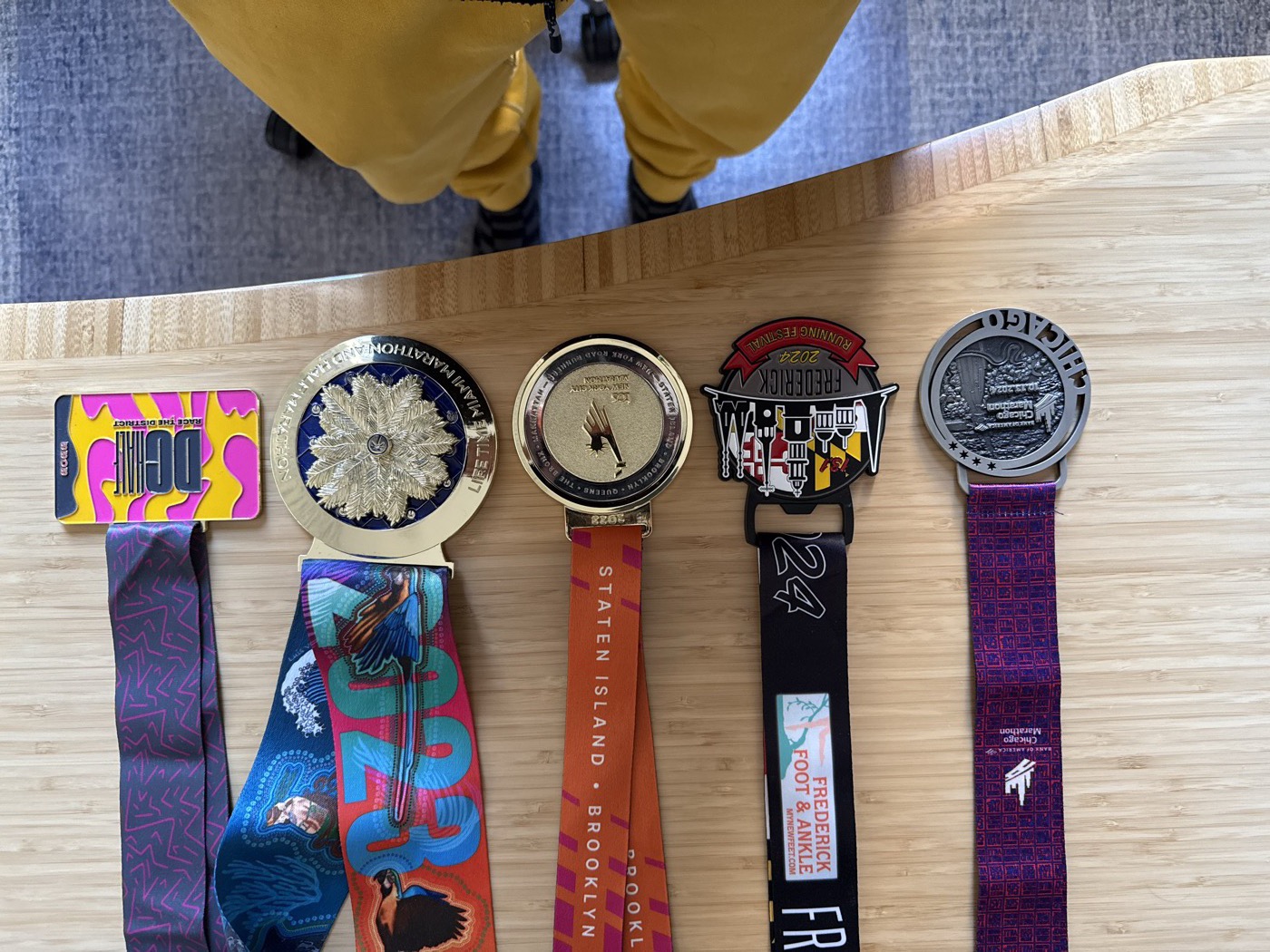
From there, distances kept growing. By September 2022, I was ready to test the half marathon. The DC Half Marathon — 13.49 miles, finished in 1:52, averaging 8:18 per mile on a flat course. I did a shakeout run the day before to burn off the nerves. Crossed the finish line and immediately started thinking about what was next.
Donut 10K — Nov 2021
6.3
miles
53:00
finish
8:44
/ mile
DC Half Marathon — Sep 2022
13.5
miles
1:52
finish
8:18
/ mile
The Shift: From Private Effort to Public Meaning (2023)
By 2023, something changed. Diabetes stopped being just a personal challenge and became something I was willing to stand behind publicly.
The year opened with the Miami Half Marathon in January 2023. 13.59 miles. 1:59 finish. 8:45 per mile with 142 feet of elevation — hot, humid, flat Miami racing. Heart rate averaged 166 and peaked at 179. A friend ran a warmup with me beforehand. We made it a thing.
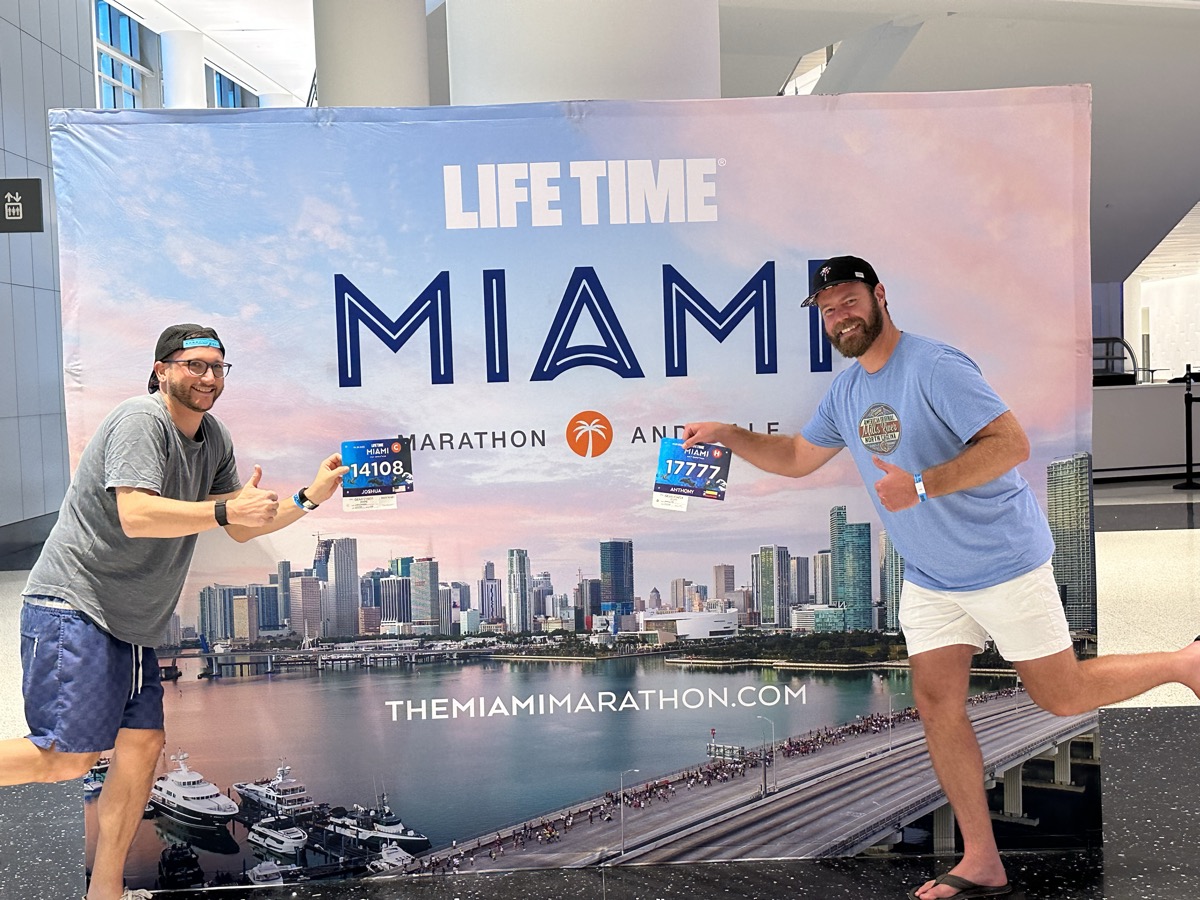
The half marathon distance became my benchmark. Long enough to be a real challenge, manageable enough to dial in fueling and glucose strategy. But I wasn't done thinking big.
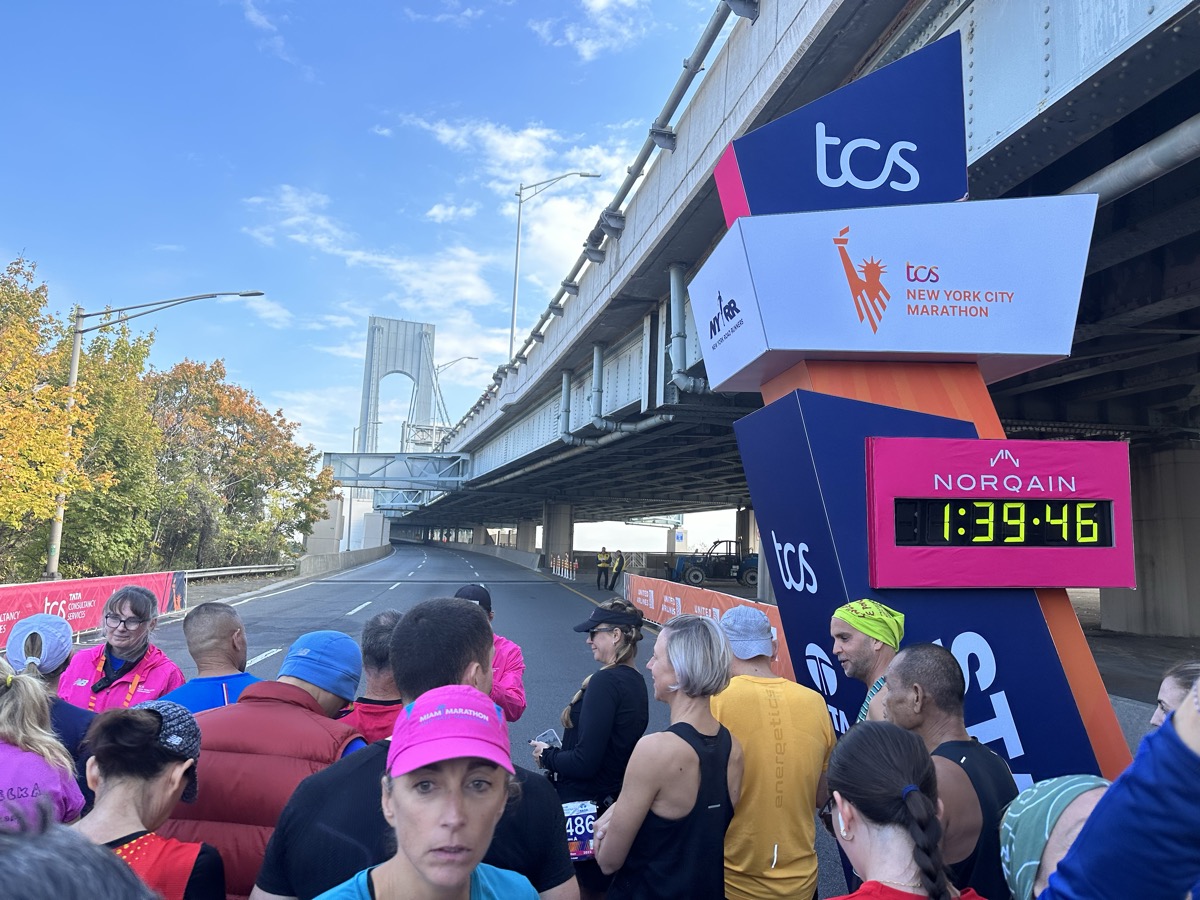
Then I went all the way: the NYC Marathon in November 2023 — home turf, five boroughs, two million spectators. My first Abbott World Marathon Major. 26.44 miles, finished in 4:32, averaging 10:17 per mile. Heart rate averaged 155 and peaked at 189. With 850 feet of elevation change, it was the hilliest race I'd run — the Verrazano Bridge alone is a gut check before mile one. I did a shakeout the day before just to keep the legs moving. I fundraised for the Leukemia & Lymphoma Society, turning miles into research dollars for blood cancer — a cause that matters to people in my life.
Miami Half — Jan 2023
13.6
miles
1:59
finish
8:45
/ mile
Avg HR 166 · Max 179 · 142ft elev
NYC Marathon — Nov 2023 Major #1
26.4
miles
4:32
finish
10:17
/ mile
Avg HR 155 · Max 189 · 850ft elev
The Performance Phase: Taking It Seriously (2024–2026)
What started as habit-building evolved into real training. Running became structured, intentional, goal-oriented.
First up: the Frederick Half Marathon in May 2024. 13.28 miles on a hilly course — 417 feet of elevation, the hardest half I'd raced. Finished in 1:49, averaging 8:13 per mile. Heart rate averaged 163 and peaked at 180. That 8:13 pace was my fastest half pace to date. I ran a shakeout the day before. Standing at the finish, I already knew the next target.
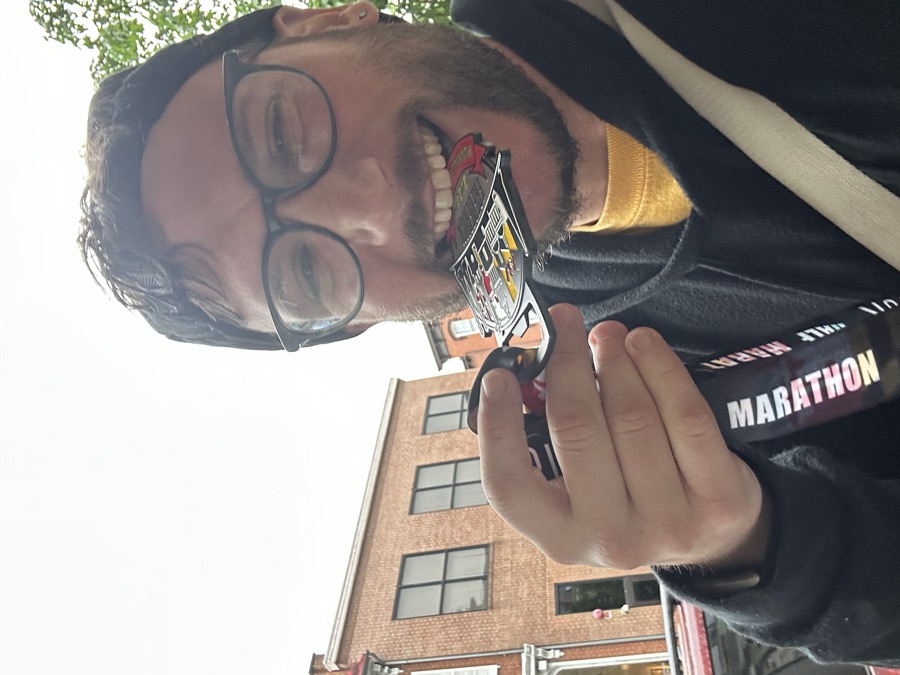
Around the same time — May 2024 — something else became a fixture: a Monday night run club. 6:48 PM, same Brooklyn block, every week. Short runs, 3–5 miles, social pace. No race bib, no glucose strategy, no performance goal. Just showing up. What the races taught about discipline, the Monday nights reinforced about community — running stopped being entirely a solo act. That habit, the same corner every Monday, became its own kind of anchor through Chicago training and beyond.
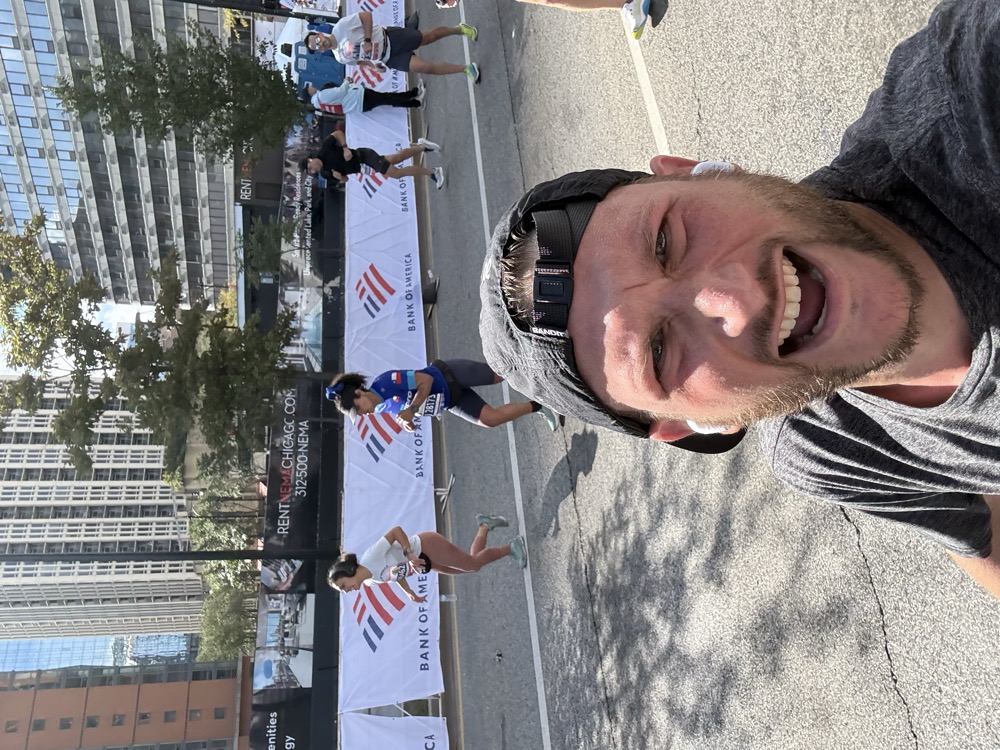
Then the main event: the Chicago Marathon in October 2024. My second Abbott World Marathon Major. I fundraised for Breakthrough T1D — the world's leading nonprofit funder of Type 1 diabetes research. As a T2 diabetic, the choice was intentional: the science they fund helps everyone living with diabetes.
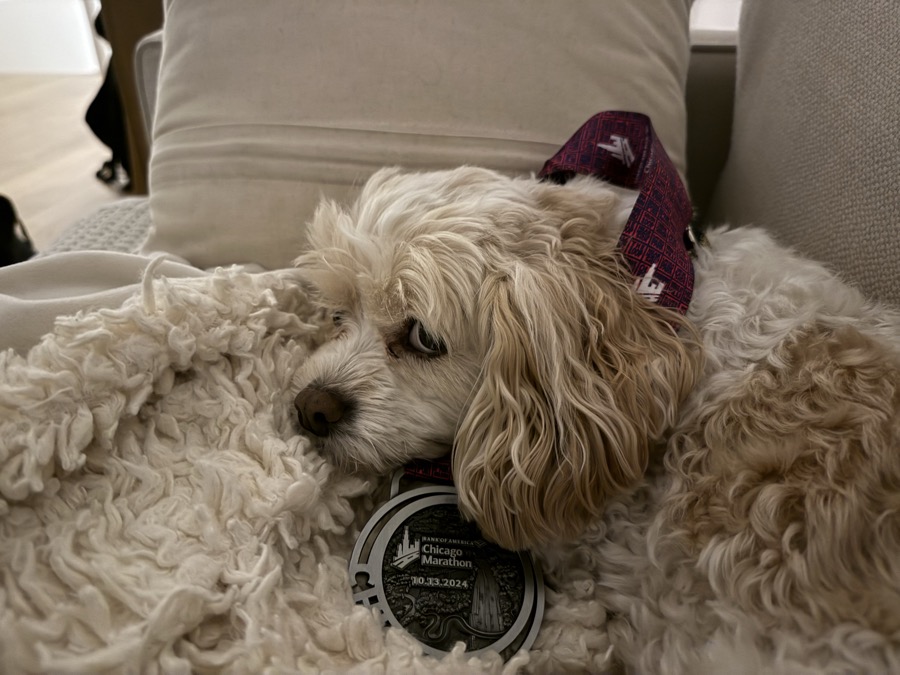
26.83 miles. Finished in 4:06 — 26 minutes faster than NYC. Averaged 9:10 per mile. Heart rate averaged 163 and peaked at 190. 381 feet of elevation on Chicago's flat streets. I did a shakeout the day before with the dog keeping pace. Race day was controlled, focused, and faster. Two World Marathon Majors done.
Frederick Half — May 2024
13.3
miles
1:49
finish
8:13
/ mile
Avg HR 163 · Max 180 · 417ft elev · fastest half pace
Chicago Marathon — Oct 2024 Major #2
26.8
miles
4:06
finish
9:10
/ mile
Avg HR 163 · Max 190 · 381ft elev · 26min PR
The goal crystallized after Chicago: run all six World Marathon Majors. Not as a bucket list item. As a statement.
Staying in Motion (Late 2024–Present)
The week after Chicago I was already running again. Not racing — just running. Three days post-marathon: 2.2 miles easy. Then a run while traveling through Austin. Then back to five-mile mornings by mid-November. There was no dramatic off-season. The habit was too ingrained to stop.
On Thanksgiving: the St. Arnold Turkey Trot 10K — 6.21 miles, 50 minutes, 8:03 pace. With the family. It wasn't a PR attempt. It was just the thing you do on a Thursday morning when running is part of who you are now.
The honest version of the post-Chicago stretch is this: it wasn't peak training. Life was busy. Runs were shorter. Some weeks were just "get something in." But there's a version of consistency that doesn't show up in a training plan — it shows up in the fact that you never really stopped. January 2025: a New Year's Day run. Then a 10-mile long run the week before Miami. Then the race.
Miami Half Marathon, February 2025 — 13.12 miles, 2:01. Not the fastest. Didn't need to be. The spring after was rebuilding mode: shorter runs, lower mileage, just keeping the habit alive through the noise.
The Monday night run club picked back up in May too. Same corner, same time, same deal.
Then the engine started turning over again. May 2025: a 10-miler in full summer humidity just because it was time to push again. July: a bridge run. October: "Happy place" — another 10-miler that felt exactly like the name. December: a 13.16-mile run just appeared on the calendar. The Strava note: "Oops ran a half."
That's what building a habit with a disease that never takes a day off looks like — eventually the habit doesn't either. January 2026: back to Miami. 13.29 miles, 1:54. Fastest Miami yet.
Turkey Trot — Nov 2024
6.2
miles
50:00
finish
8:03
/ mile
Miami Half — Feb 2025
13.1
miles
2:01
finish
9:14
/ mile
Miami Half — Jan 2026
13.3
miles
1:54
finish
8:34
/ mile
Fastest Miami yet
Marathon training with diabetes forces you to think about fueling strategies, blood glucose stability over long efforts, recovery timing, and consistency over months not days. At this stage it's no longer about "can I do this?" — it's about how far can I push this while staying in control?
| Race | City | Status |
|---|---|---|
| TCS New York City Marathon | New York | ✓ Done (2023) |
| Bank of America Chicago Marathon | Chicago | ✓ Done (2024) |
| BMW Berlin Marathon | Berlin | TBD |
| Boston Marathon | Boston | Upcoming |
| TCS London Marathon | London | Upcoming |
| Tokyo Marathon | Tokyo | Upcoming |
Full Race History
| Date | Race | Distance |
|---|---|---|
| Nov 2021 | Donut 10K | 10K |
| Sep 2022 | DC Half Marathon | Half Marathon |
| Jan 2023 | Miami Half Marathon | Half Marathon |
| Nov 2023 | TCS NYC Marathon Major #1 | Marathon |
| May 2024 | Frederick Half Marathon | Half Marathon |
| Oct 2024 | Bank of America Chicago Marathon Major #2 | Marathon |
| Nov 2024 | St. Arnold Turkey Trot | 10K |
| Feb 2025 | Miami Half Marathon | Half Marathon |
| Jan 2026 | Miami Half Marathon | Half Marathon |
The Tech Angle: Building My Own Tools
I'm a solutions engineer by trade, and I think like a technologist. So naturally, I didn't just run with diabetes — I started building tools to manage it better.
The first idea was a unified dashboard pulling data from all my devices: Dexcom CGM for glucose, MyFitnessPal for nutrition, Garmin for activity, Whoop for recovery. One view showing correlations between diet, activity, sleep, and blood sugar.
The stock Dexcom Connect IQ app for Garmin was garbage. So I built a custom data field — real-time glucose display for my watch during runs. Large numbers, trend arrows, color-coded zones, exercise-specific alert thresholds. Glance at your wrist mid-run and instantly know where your blood sugar is heading.
Then I took 158 Strava runs and built a personalized effort prediction model — calibrating heart rate zones, pace thresholds, and cadence baselines to my specific physiology, not generic formulas. That feeds into a Garmin data field showing a single 1–10 effort score, calibrated to me. Phase 2: an AI pacing coach powered by Claude's API that sends real-time coaching cues to my watch during a run. Cost: about two cents per run.
I also reverse-engineered Abbott's LibreLinkUp API (they don't have a developer portal — I built one anyway) into a Python CLI. One command, libre now, and I see my current blood sugar with a trend arrow in my terminal.
And when I interviewed for a role at CockroachDB, I didn't use synthetic data. I loaded my actual Strava runs — 27 from my Miami Half Marathon training block — and simulated my Garmin watch streaming GPS and heart rate data at 50 events per second. My running data became my technical story.
Why I Fundraise
Racing and fundraising go together for me. For NYC in 2023, I raised money for the Leukemia & Lymphoma Society — turning miles into research funding for blood cancer, a cause that matters to people in my life. For Chicago in 2024, I ran for Breakthrough T1D — the world's leading nonprofit funder of Type 1 diabetes research. As a T2 diabetic, the choice was intentional: the research they fund benefits everyone living with diabetes, regardless of type.
For Berlin and beyond, the details are still coming together — but the commitment to running with purpose isn't going anywhere.
The Throughline
If you zoom out, this story isn't really about diabetes. It's about progression:
Most people stall somewhere in the middle of that curve.
And because I'm a technologist, every phase of the health journey generated a project. The diagnosis led to the management app. The training led to the Garmin tools. The performance phase led to the AI coaching system. The advocacy led to this website. The daily management led to the LibreView CLI and a barcode-scanning food tracker.
The running and the building feed each other. Every mile teaches me something about managing diabetes. Every tool I build makes the next mile a little more informed. And every finish line — whether it's a race or a shipped project — proves the same thing:
Diabetes doesn't set your limits. You do.
Want to Help?
Support my fundraising efforts for Breakthrough T1D — every dollar goes directly to research.
See How to Support